Artificial Intelligence (AI) has the potential to fundamentally transform construction project management by turning scattered project data into actionable insights across the entire project lifecycle. From early planning to final handover, AI can support better decisions, reduce risks, and improve cost, time, and quality outcomes. This article explores how AI can be applied at each major stage of a construction project.
1. Initialization and Planning Stage
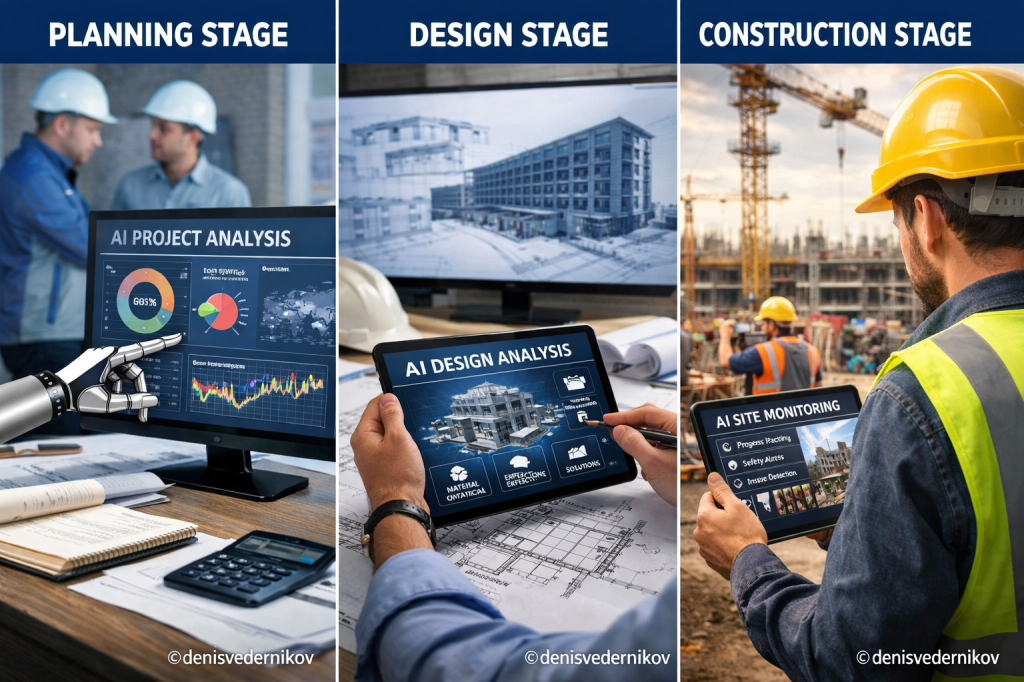
The planning stage sets the foundation for the entire project, and errors made here are often amplified later. AI can significantly enhance this phase by analyzing large datasets of past and ongoing projects—so-called project analogues.
Using machine learning algorithms, AI systems can compare the planned project with similar completed projects based on parameters such as building type, size, location, construction method, and contract model. This allows for more realistic cost estimation and schedule forecasting, reducing optimism bias and underestimation risks.
AI can also assist in preparing an effective Work Breakdown Structure (WBS). By analyzing successful WBS models from previous projects, AI can suggest optimal task decomposition, identify missing activities, and flag overly granular or vague work packages. This leads to better scope definition and clearer responsibility allocation.
Beyond cost and WBS development, AI can support:
- Risk identification and assessment, by detecting patterns of delays, disputes, or cost overruns in similar projects.
- Resource demand forecasting, estimating labor, equipment, and material needs over time.
- Scenario analysis, quickly testing multiple planning alternatives and their impacts on budget and schedule.
- Regulatory and compliance checks, ensuring early alignment with local codes and permitting requirements.
In essence, AI helps transform planning from an experience-driven exercise into a data-driven process.
2. Design Stage
The design stage is where most lifecycle costs are determined, even though only a small portion of the budget is spent. AI can play a crucial role in improving design quality, efficiency, and constructability.
AI tools can analyze architectural, structural, and MEP design sections and compare them with vast libraries of existing designs and BIM models. This comparison enables identification of the most effective technical solutions based on performance, cost, and constructability metrics.
AI can also recommend more suitable materials by evaluating factors such as availability, durability, sustainability, cost trends, and compatibility with other systems. For example, AI may suggest alternative façade systems or structural materials that reduce cost without compromising performance.
Another major contribution is the detection of design errors and clashes. AI-enhanced design review systems can identify inconsistencies, missing information, over-designed elements, and conflicts between disciplines faster and more reliably than manual checks.
Additional AI applications at this stage include:
- Constructability analysis, predicting construction challenges before they occur.
- Energy and sustainability optimization, evaluating energy performance and carbon footprint of design alternatives.
- Value engineering support, automatically proposing cost-saving design options.
- Design change impact analysis, assessing how modifications affect cost, time, and downstream activities.
AI therefore acts as an intelligent design assistant, improving both technical and economic outcomes.
3. Tendering Stage
The tendering stage involves processing large volumes of data under tight deadlines, making it an ideal candidate for AI support.
AI systems can analyze Bills of Quantities (BoQs), material and equipment sets, and technical specifications to identify inconsistencies, omissions, or unusually high or low quantities. This improves the quality of tender documentation and reduces claims risk.
When evaluating bidders, AI can analyze pools of contractors using historical performance data, including cost accuracy, schedule adherence, quality records, safety performance, and litigation history. Quotations can be assessed not only on price but also on technical feasibility and risk exposure.
AI can further support:
- Bid normalization, ensuring fair comparison between different pricing structures.
- Detection of unbalanced bids, where contractors manipulate unit rates.
- Supply chain risk analysis, identifying vulnerabilities related to specific suppliers or materials.
- Market trend analysis, forecasting price fluctuations for key materials and equipment.
By combining technical and economic analysis, AI helps select the most economically and technically efficient proposal, rather than simply the lowest bid.

4. Construction Stage
The construction stage generates massive amounts of real-time data, from daily reports to photos and sensor readings. AI can turn this data into continuous performance monitoring and proactive decision-making.
AI can analyze daily construction routines and productivity rates, comparing them with planned values and historical benchmarks. Deviations can be detected early, allowing corrective actions before delays escalate.
Image recognition and computer vision technologies enable automated processing of site photos and videos. AI can verify completed works, track progress, identify safety violations, and detect quality issues such as improper installations or incomplete works.
AI can also manage and analyze snag lists and deficiencies, identifying recurring issues, responsible subcontractors, and root causes.
Additional AI capabilities include:
- Schedule optimization, dynamically adjusting construction schedules based on actual progress and previous project outcomes.
- Predictive delay analysis, forecasting potential delays before they occur.
- Equipment utilization tracking, improving efficiency and reducing idle time.
- Health and safety monitoring, detecting unsafe behaviors or hazardous conditions.
In this stage, AI functions as a real-time project control system, continuously learning and adapting.
5. Handover and Commissioning Stage
The handover and commissioning stage is critical for client satisfaction and long-term asset performance. AI can streamline and improve this phase by ensuring completeness, accuracy, and transparency.
AI can process and prioritize snag lists, grouping issues by system, location, or contractor, and predicting the time required for closure. Cost deviations between planned and actual expenditures can be analyzed to identify the main drivers of overruns or savings.
AI can also support:
- Verification of as-built documentation, ensuring alignment with design intent.
- Commissioning data analysis, validating system performance against requirements.
- Preparation of lessons learned, automatically extracting insights from project data.
- Creation of digital twins, enabling better operation and maintenance after handover.
By systematically capturing and analyzing project knowledge, AI ensures that lessons learned are not lost but carried forward to future projects.
Conclusion
AI has the potential to reshape construction project management by enhancing decision-making across all project stages. Rather than replacing project managers, AI augments their capabilities, enabling them to focus on strategy, collaboration, and leadership. As data availability and AI technologies continue to evolve, their integration into construction management will move from competitive advantage to industry standard, driving better outcomes for all stakeholders.