Value Engineering Implementation Strategy
This slide outlines the practical steps required to implement the proposed value engineering measures and convert the identified optimization potential into a finalized project budget.
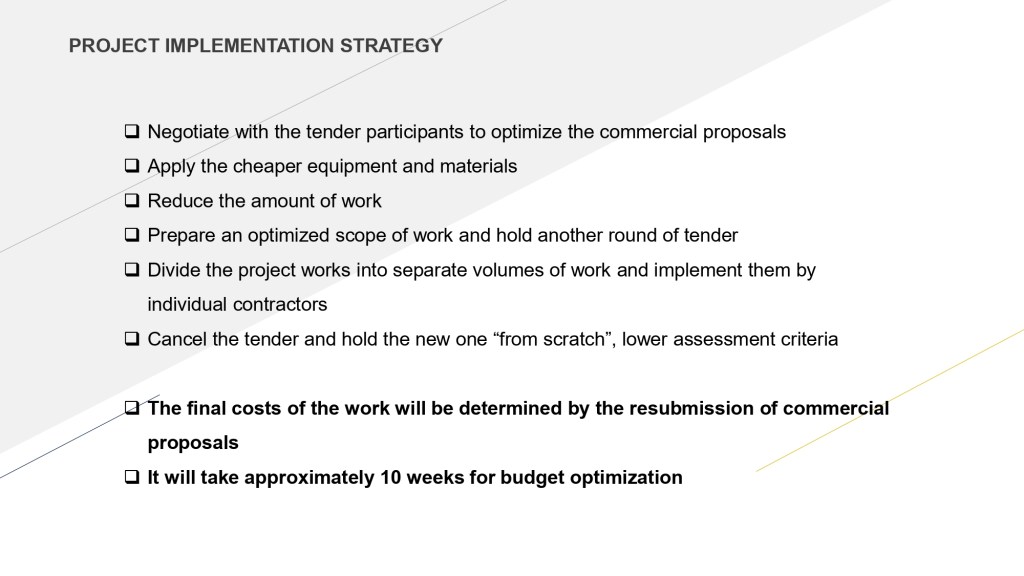
The strategy is based on a competitive and iterative approach to procurement and scope management:
- First, negotiations with current tender participants will be conducted to improve commercial terms and reflect the optimized technical and functional solutions.
- Where technically acceptable, more cost-effective equipment and materials will be applied without compromising performance, safety, or compliance.
- The overall volume of work will be reduced in line with the approved optimization stages.
- An optimized scope of work will be prepared, followed by an additional tender round to ensure market-based pricing under the revised scope.
- To increase competition and flexibility, the project may be divided into separate work packages, allowing engagement of specialized contractors for individual scopes.
- If necessary, the existing tender can be cancelled and relaunched from scratch, with adjusted evaluation criteria focused more strongly on cost efficiency while maintaining minimum technical requirements.
As a result:
- Final project costs will be determined by the resubmission of commercial proposals, ensuring that savings are confirmed by the market rather than assumed.
- The full value engineering and re-tendering process is expected to take approximately 10 weeks.
Overall, this strategy ensures that the optimization results presented in the previous slides are realistic, achievable, and contractually enforceable, providing management with a clear roadmap from concept to execution.
Project Optimization Summary
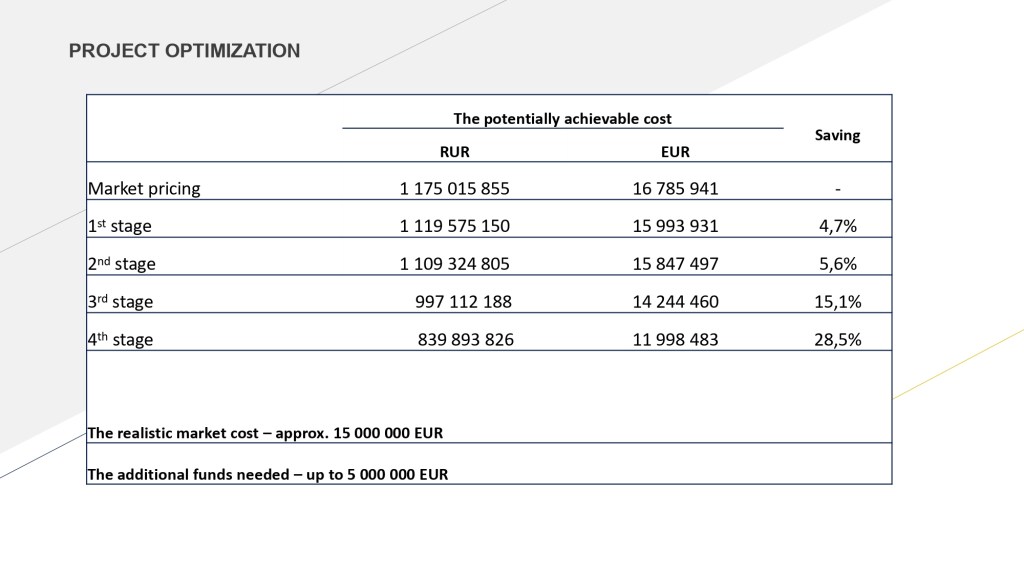
This slide illustrates the cost-optimization potential of the project through a structured, multi-stage approach.
I start with market pricing, which reflects the initial benchmark cost based on standard market conditions. From this baseline, the project undergoes four consecutive optimization stages, each delivering incremental cost reductions through improved technical solutions, procurement efficiency, scope refinement, and execution strategy.
- Stage 1 and Stage 2 demonstrate early, low-risk optimizations, achieving savings of around 5–6%, primarily through alignment with realistic market assumptions and changing the engineering equipment.
- Stage 3 introduces more substantial efficiencies, resulting in nearly 15% savings, driven by deeper design and commercial optimization.
- Stage 4 represents the maximum achievable optimization scenario, where the total cost is reduced by almost 29% compared to the original market pricing.
Stage 1 – Volumes Adjustments
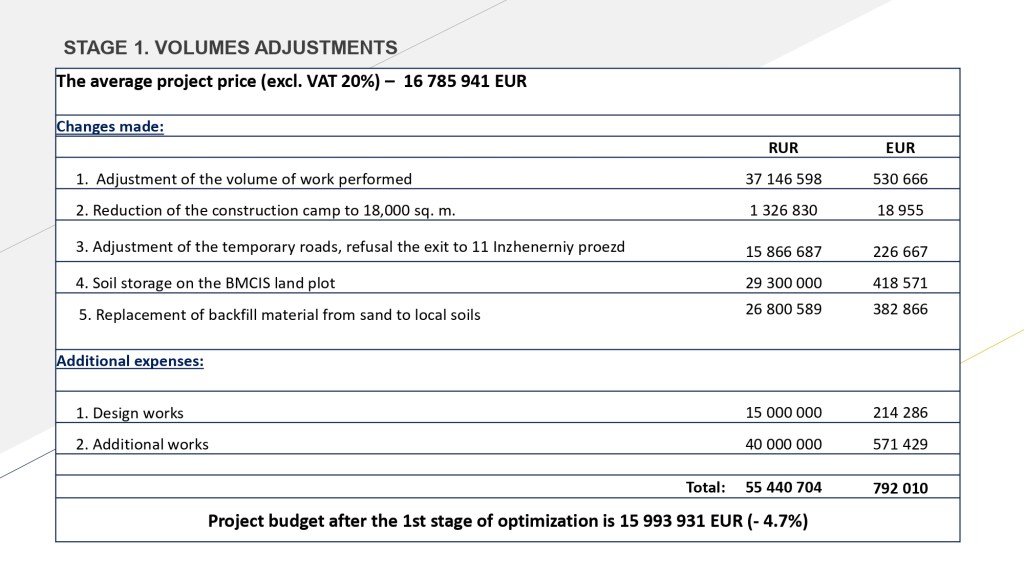
During Stage 1, several practical and low-risk adjustments were implemented:
- Adjustment of the volume of work performed to reflect verified scope and realistic execution requirements.
- Reduction of the construction camp area to 18,000 sq. m, eliminating excess temporary facilities.
- Optimization of temporary roads, including refusal of the exit to 11 Inzhenerniy Proezd, which reduced unnecessary infrastructure works.
- Soil storage directly on the BMCIS land plot, minimizing transportation and disposal costs.
- Replacement of imported sand with local soils for backfilling, maintaining technical compliance while reducing material and logistics costs.
These measures generated gross savings, partially offset by additional necessary expenses, such as:
- Design works, required to formalize and validate the revised technical solutions.
- Additional works, associated with implementing the optimized scope.
After accounting for both savings and additional expenses, the net effect of Stage 1 optimization is:
- Total savings: approximately 792,000 EUR
- Budget reduction: 4.7%
As a result, the project budget after the first optimization stage is reduced to 15.99 million EUR, demonstrating that meaningful cost reductions can be achieved early in the project without impacting functionality, quality, or schedule.
Stage 2 – Changing the Engineering Equipment
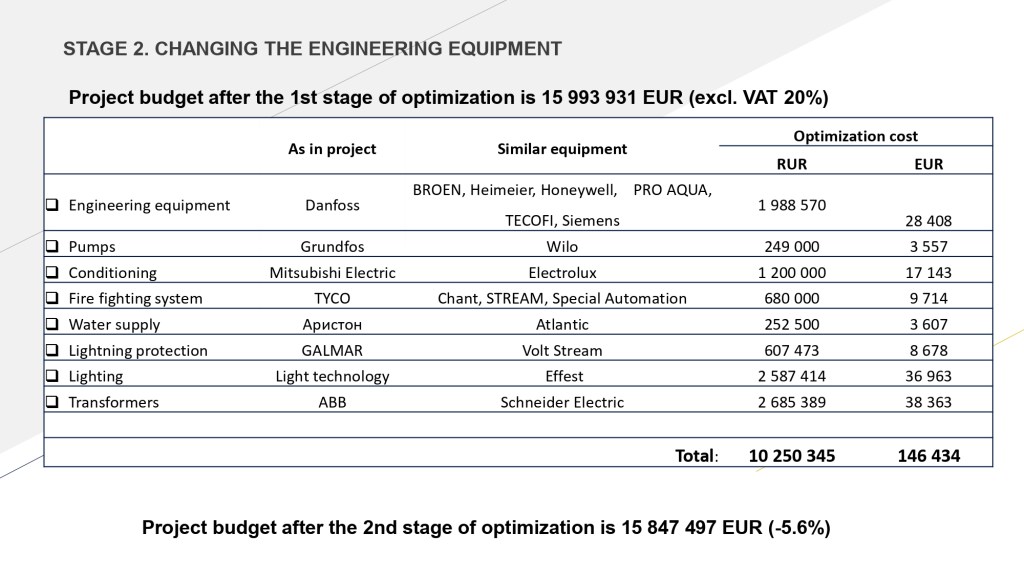
This slide presents the second stage of project optimization, which focuses on replacing specified engineering equipment with technically equivalent alternatives that meet the same performance, safety, and regulatory requirements.
Overall, Stage 2 demonstrates that significant savings can be achieved through brand optimization and competitive sourcing, without compromising technical quality, safety standards, or long-term operability.
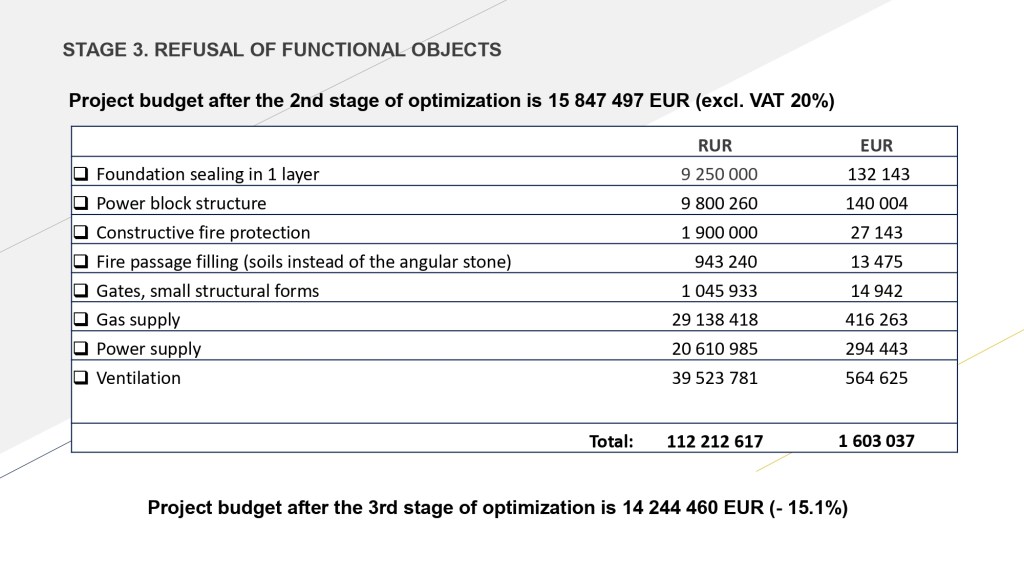
Stage 3 – Refusal of Functional Objects
This slide presents the third stage of project optimization, which focuses on removing or simplifying non-critical functional objects and systems that are not essential for the core operation of the facility.
Stage 3 optimization is based on a functional necessity review, where each element of the project was evaluated against three criteria:
- operational necessity,
- regulatory compliance,
- impact on safety and reliability.
As a result, after implementing Stage 3 measures, the project budget is reduced to 14.24 million EUR, representing a 15.1% reduction compared to the original market-based budget.
Stage 3 delivers the largest single cost reduction in the optimization program and reflects a strategic decision to focus strictly on essential functionality while maintaining compliance, safety, and operational integrity.
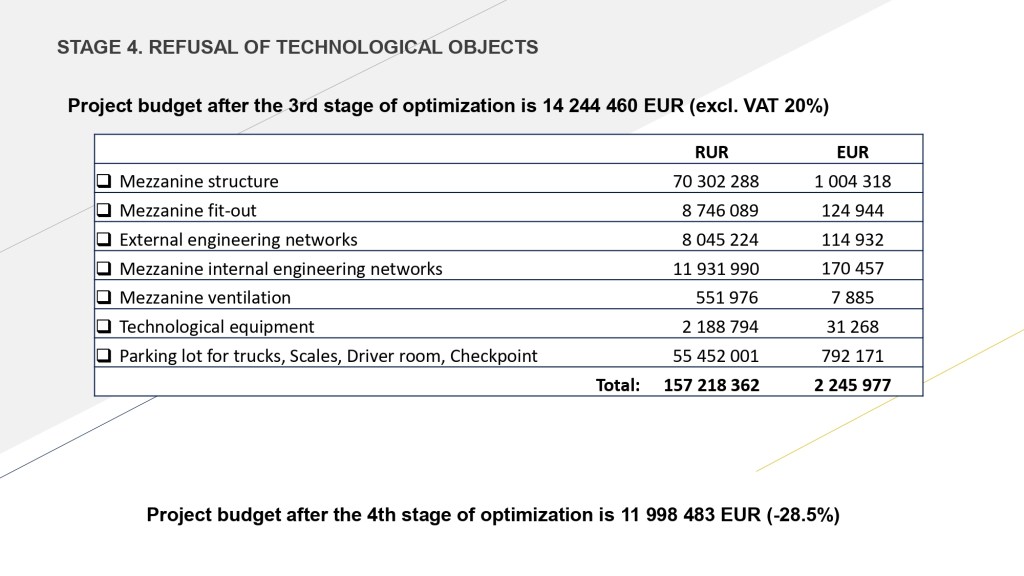
Stage 4 – Refusal of Technological Objects
This slide presents the fourth and final stage of project optimization, which focuses on excluding technological objects and auxiliary infrastructure that are not required for the base operational scenario of the project.
Stage 4 represents a strategic optimization scenario, where the project scope is reduced to a minimum viable configuration. The goal is not further efficiency within the same concept, but a deliberate simplification of the technological model.
As a result, after implementing Stage 4 optimizations, the project budget is reduced to 12.0 million EUR, representing a 28.5% reduction compared to the original market-based estimate.
Stage 4 defines the lowest possible cost boundary of the project and serves as a reference scenario for decision-making. It clearly shows the trade-off between capital expenditure and operational flexibility, enabling stakeholders to choose the most appropriate optimization level based on strategic priorities.
©denisvedernikov
 Denis Vedernikov