
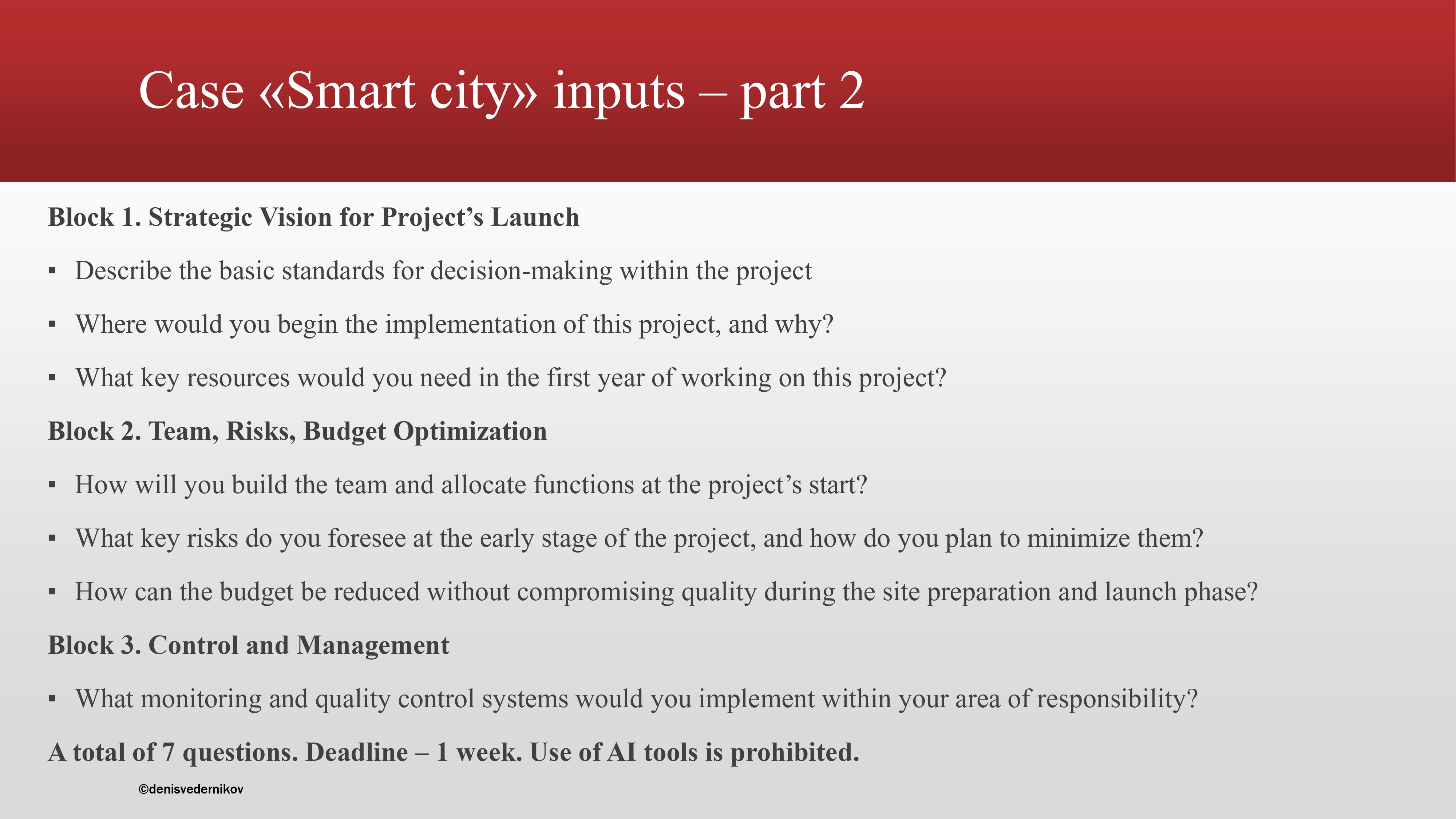


At the core of the deck is a detailed case study built around the idea of developing a smart city from the ground up. The project context assumes a greenfield site where no engineering or social infrastructure yet exists, aside from an approved master plan and government support. The assignment challenges the project director to design and implement an effective strategy, identify and mitigate risks, foster collaboration with stakeholders, and maintain quality throughout all stages. The aim is not only to deliver physical infrastructure but also to test strategic vision, systems thinking, leadership, and resilience under uncertainty.
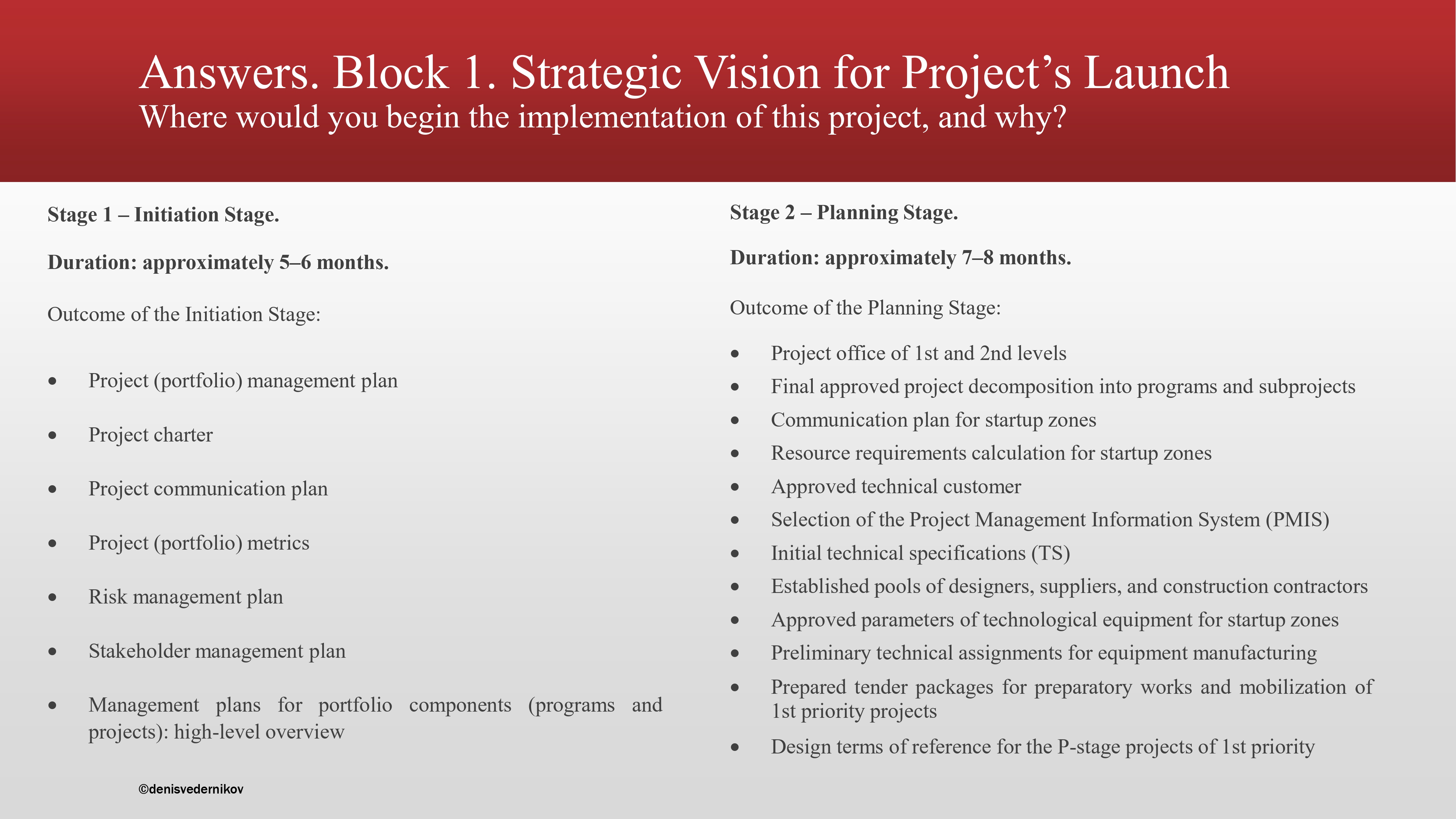
The case is divided into structured blocks of questions. The first block focuses on strategic vision, decision-making standards, and the initial steps required to launch such a vast project. International best practices and frameworks—including PMBoK, PRINCE2, ISO standards, FIDIC guidelines, Lean Construction, ESG, and Integrated Project Delivery (IPD)—are recommended as guiding principles. The presentation emphasizes that early stages should focus on initiation and planning, lasting more than a year in total. Outcomes at these stages include project charters, communication and risk management plans, a portfolio decomposition, and the establishment of project offices and technical specifications.
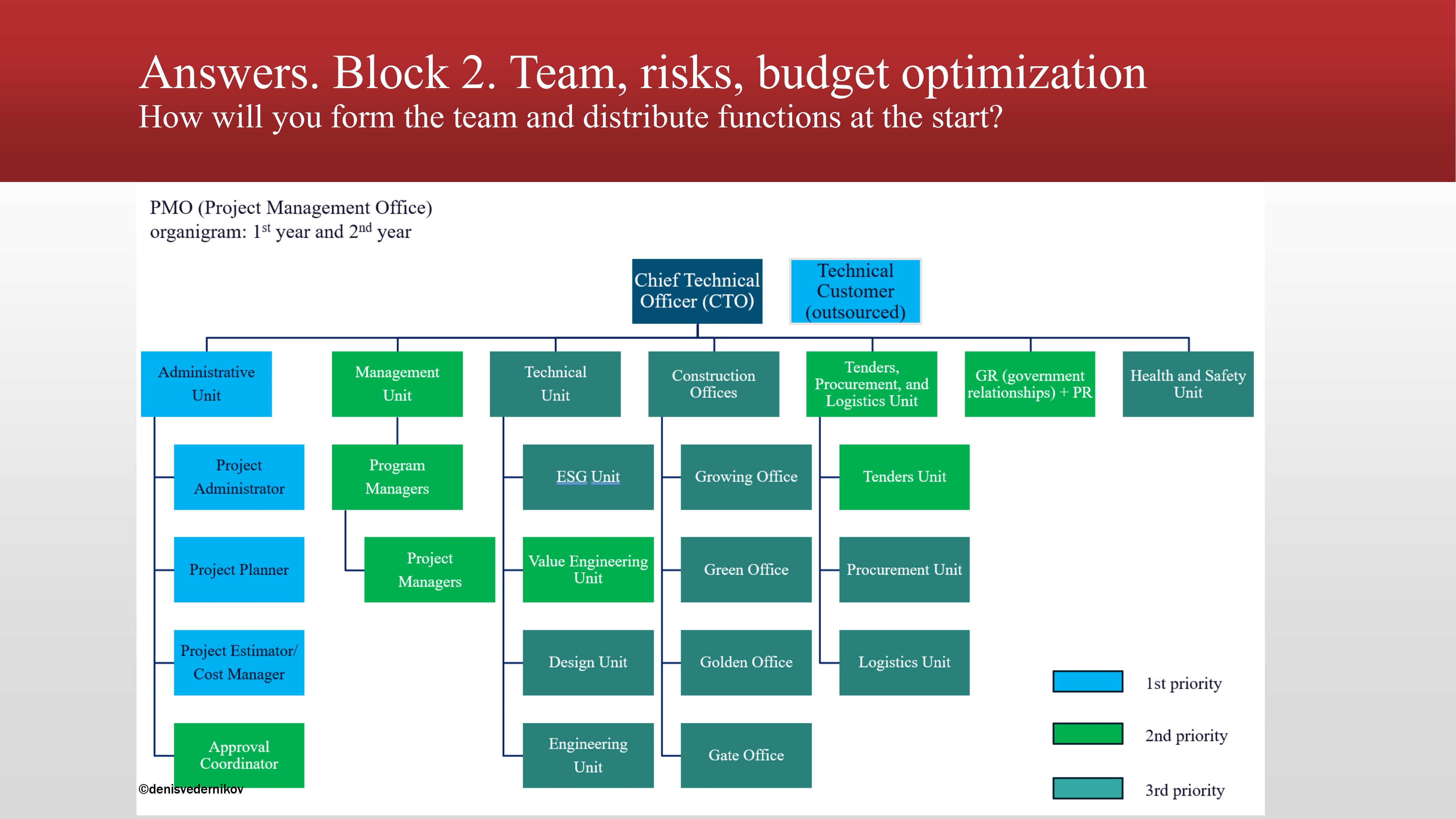
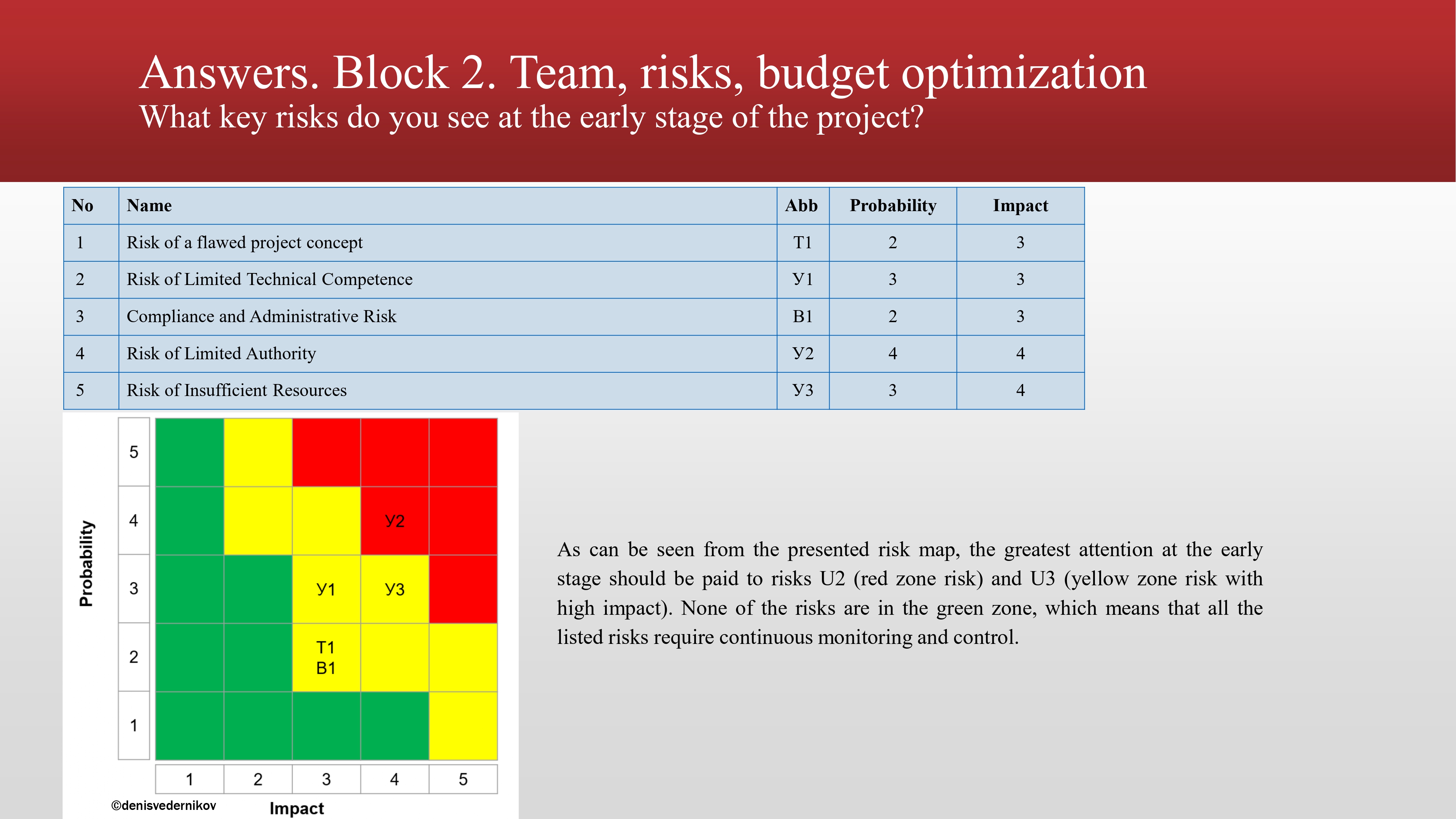
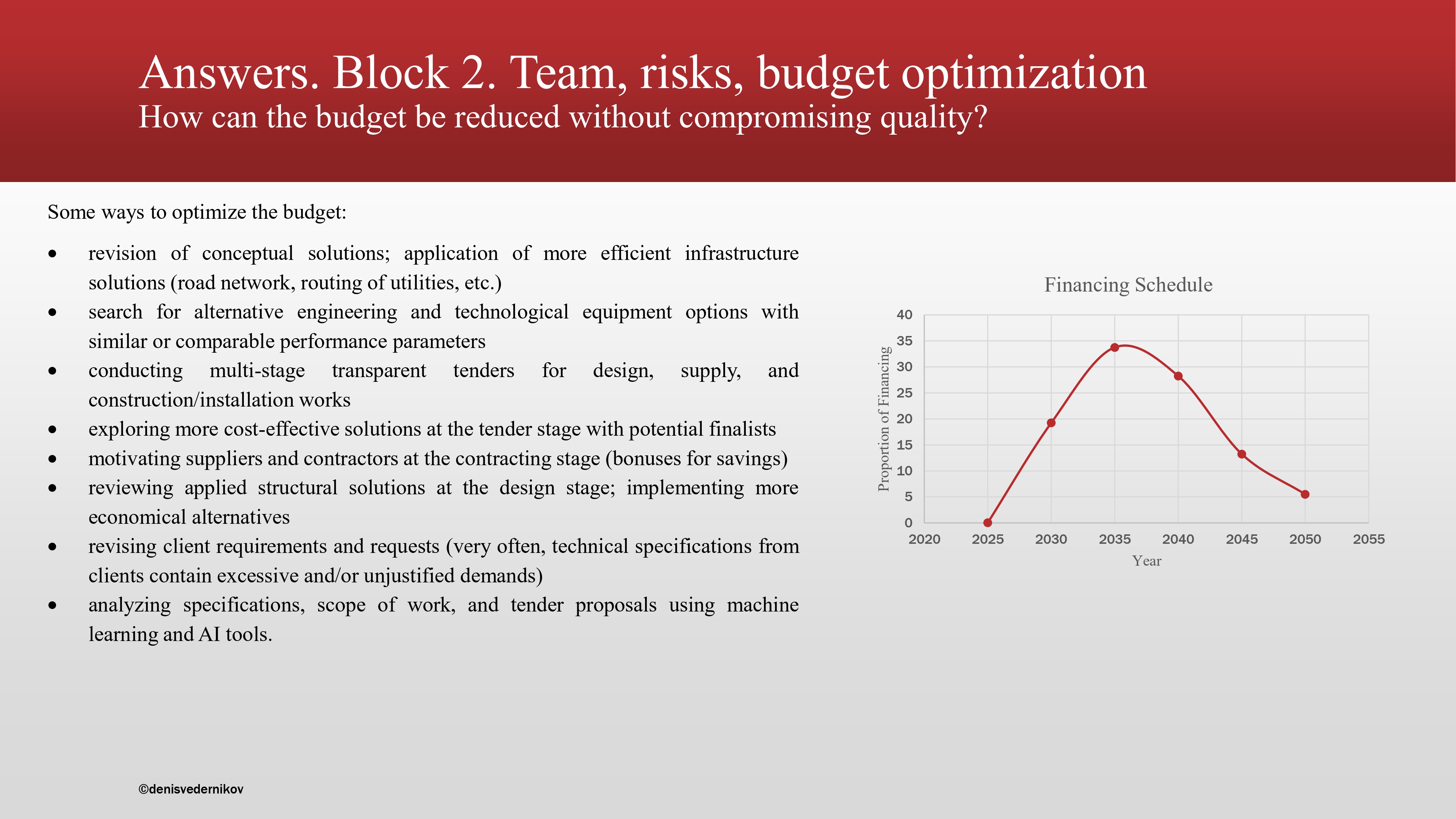
The second block addresses team formation, risk assessment, and budget optimization. The slides stress building a clear organizational structure, allocating functions effectively, and continuously monitoring high-impact risks. Among the most critical risks are limited authority, insufficient resources, flawed concepts, and compliance issues. None of the risks fall into the “green zone,” meaning that constant vigilance is required. Strategies for cost optimization are pragmatic, such as revising conceptual designs, conducting transparent multi-stage tenders, motivating contractors with savings incentives, and applying AI tools to analyze specifications. Budget efficiency is linked not only to financial prudence but also to creativity in technical solutions and procurement practices.
The third block turns to monitoring and quality control. It proposes a comprehensive, multi-layered system that operates across portfolio, program, and subproject levels. Quality assurance is embedded at every stage: from concept validation and design documentation, through tendering and contracting, to construction and installation. Both internal audits and external independent reviews are considered necessary, along with regular monitoring of client satisfaction. This end-to-end approach reflects a philosophy where governance, accountability, and continuous improvement are inseparable from technical execution.
In summary, the deck presents a holistic framework for managing a comprehensive development project. It blends rigorous adherence to international standards with pragmatic solutions for cost, risk, and quality management. Beyond technical expertise, it underscores the importance of trust, collaboration, and leadership in environments characterized by complexity and uncertainty.
©denisvedernikov
 Denis Vedernikov