The article examines how Industry 5.0—a new paradigm emphasizing human-centricity, sustainability, and resilience—is transforming the theory and practice of project management. Building on the technological foundations of Industry 4.0, Industry 5.0 shifts the focus from automation and efficiency toward integrating human values, ethical considerations, and societal impact into industrial and organizational systems.
This is a summary of the article: Dani, I., Ke, Y., & Kilani, S. A. (2026). The Future of Project Management in Industry 5.0: A Narrative Literature Review. Project Management Journal, 57(2), 222-239.
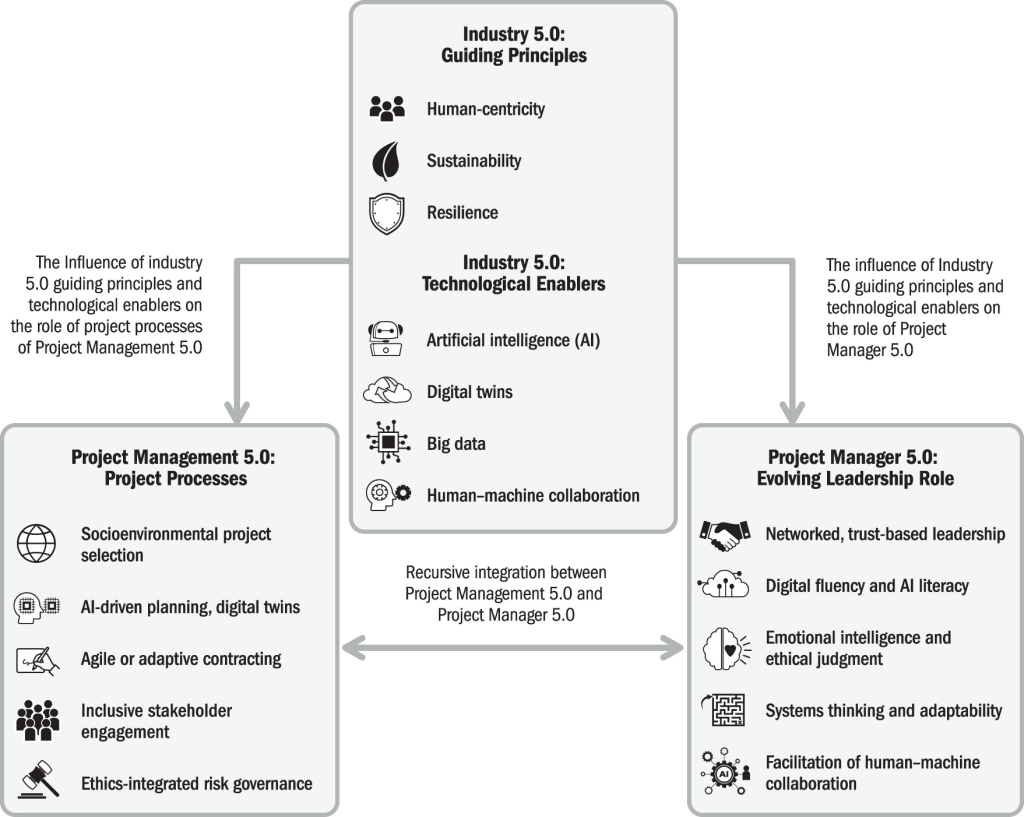
Figure 1. Conceptual framework illustrating how Industry 5.0 principles and technology exert simultaneous influence on project management processes (PM 5.0) and leadership roles (Project Manager 5.0), which in turn reinforce and shape each other through a recursive integration.
Note. From The Future of Project Management in Industry 5.0: A Narrative Literature Review, by Shankar Sankaran, Ralf Müller, Nicholas Drouin, and Kam Jugdev, 2025, Project Management Journal (https://doi.org/10.1177/87569728251386332). Licensed under CC BY 4.0.
1. Industry 5.0 as a New Paradigm
Industry 5.0 is more than a technological evolution—it is a conceptual and philosophical shift. While Industry 4.0 focused on digitalization, automation, and data-driven efficiency, Industry 5.0 emphasizes:
- Human well-being and empowerment
- Sustainable and environmentally responsible practices
- Organizational and societal resilience
This paradigm introduces a “triple bottom line” approach, where value is measured not only in economic terms but also in social and environmental outcomes.
As a result, project management must evolve from a purely technical discipline into a multidimensional, socio-technical system that balances technology with human and societal needs.
2. Reframing Project Management as a Sociotechnical System
A central argument of the article is that project management in Industry 5.0 should be understood as a sociotechnical system—a system where human actors, technologies, and organizational structures interact dynamically.
This reconceptualization challenges traditional assumptions such as:
- Projects as linear, controllable processes
- Efficiency as the primary success metric
- Managers as purely rational decision-makers
Instead, projects are seen as complex, adaptive environments where value is co-created by humans and technologies.
This shift requires integrating insights from multiple disciplines, including:
- Organizational theory
- Innovation studies
- Digital ethics
- Sustainability science
3. Key Transformations in Project Management Practices
There are several major changes in how projects are managed under Industry 5.0:
a. AI-Enabled and Data-Driven Management
Artificial intelligence and advanced analytics are transforming decision-making processes. AI supports:
- Predictive planning
- Real-time monitoring
- Enhanced decision accuracy
However, it also raises concerns about decision authority, transparency, and trust, requiring new governance models.
b. Networked and Collaborative Structures
Projects are increasingly inter-organizational and network-based, involving multiple stakeholders across ecosystems. Collaboration becomes a key capability, supported by digital platforms and technologies like blockchain.
c. Value-Driven and Ethical Orientation
Projects are no longer judged solely within cost, time, and scope. Instead, they are evaluated based on:
- Social impact
- Environmental sustainability
- Ethical considerations
This expands the definition of project success.
4. The Concept of “Project Management 5.0”
“Project Management 5.0” is a conceptual model that reflects the evolving nature of project work.
This model emphasizes:
- Adaptability: Projects must respond dynamically to changing environments
- Integration: Combining technological, human, and organizational elements
- Ethics and responsibility: Embedding societal values into project design and execution
- Resilience: Ensuring projects can withstand disruptions
Project Management 5.0 positions projects as vehicles for sustainable and responsible value creation rather than just tools for delivering outputs.
5. The Role of the “Project Manager 5.0”
The concept “Project Manager 5.0” redefines the competencies required for future project leaders.
Key competencies include:
- Emotional intelligence and social skills: Managing diverse teams and fostering collaboration
- Ethical judgment: Navigating complex moral and societal issues
- Technological literacy: Understanding AI, data analytics, and digital tools
- Systems thinking: Viewing projects as interconnected sociotechnical systems
- Leadership in uncertainty: Guiding teams through ambiguity and change
Rather than being a controller or planner, the project manager becomes a “sensemaker,” facilitator, and integrator of human and technological elements.
6. Organizational Capabilities and Resilience
There is a crucial need for organizations to develop new capabilities to succeed in Industry 5.0:
- Collaborative agility: The ability to form and manage partnerships effectively
- Dynamic capabilities: Adapting resources and strategies in response to change
- Resilience: Maintaining performance under uncertainty and disruption
Governance structures must also evolve to support:
- Distributed decision-making
- Transparency and accountability
- Integration of human and AI decision processes
7. Redefining Project Productivity and Value
Traditional measures of productivity—focused on efficiency and output—are no longer sufficient.
The article proposes a multidimensional view of productivity, incorporating:
- Cognitive contributions (knowledge and decision-making)
- Relational factors (collaboration and trust)
- Systemic outcomes (long-term value creation)
This broader perspective aligns with Industry 5.0’s emphasis on sustainable and human-centered value creation.
Denis Vedernikov
©denisvedernikov
Minor assistance from ChatGPT (OpenAI, 2026) was used to check wording and formatting. No substantial content was generated without review.
 Denis Vedernikov
Leave a comment